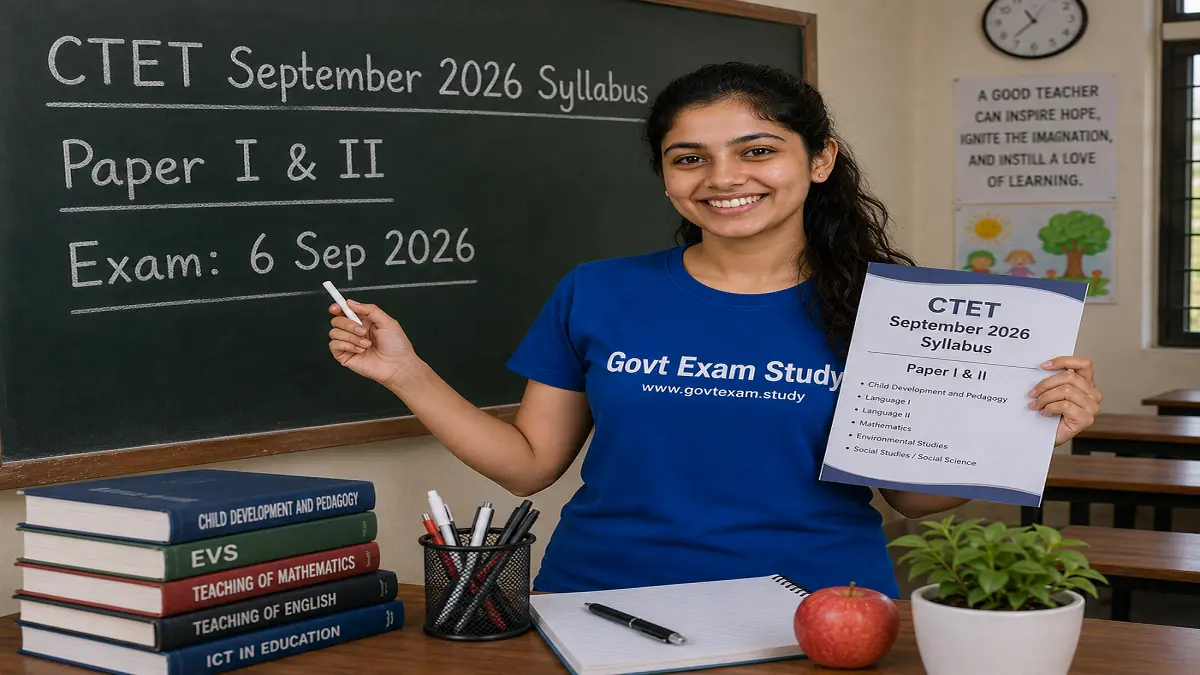
CTET September 2026 Syllabus Out: Download Paper I & Paper II Detailed Syllabus PDF, Exam on 6 Sep
Short Information:
CTET September 2026 Syllabus has been released by CBSE for Paper I (Classes I-V) and Paper II (Classes VI-VIII). The CTET exam will be held on 6th September 2026. The syllabus includes Child Development and Pedagogy, Mathematics, EVS, Languages, Science, and Social Science. No negative marking, 150 MCQs, 150 marks each paper. Qualifying marks: 60% for General, 55% for SC/ST/OBC/PwBD. CTET certificate is valid for lifetime.
You can check all updates including CTET syllabus PDF download, admit card, answer key, and result only on our official website www.govtexam.study
CTET September 2026 Syllabus: Complete Paper I & Paper II Detailed Syllabus with Subject-wise Topics
CTET September 2026 Syllabus: Paper I & Paper II Detailed Syllabus PDF Download
Hello friends, if you are preparing for the Central Teacher Eligibility Test (CTET) September 2026, then you have come to the right place. The Central Board of Secondary Education (CBSE) will conduct the 22nd edition of CTET on 6th September 2026. The exam has two papers – Paper I for Classes I to V and Paper II for Classes VI to VIII. In this post, we have provided the complete detailed syllabus for both papers subject-wise. Read this post carefully and start your preparation.
| Organization | Central Board of Secondary Education (CBSE) |
|---|---|
| Exam Name | Central Teacher Eligibility Test (CTET) – September 2026 |
| Edition | 22nd Edition |
| Paper I For | Classes I to V (Primary Stage) |
| Paper II For | Classes VI to VIII (Elementary Stage) |
| Exam Date | 6th September 2026 (Sunday) |
| Official Website | ctet.nic.in |
CTET September 2026 – Exam Structure at a Glance
| Paper | For Classes | Total Questions | Total Marks | Duration | Negative Marking |
|---|---|---|---|---|---|
| Paper I | I to V | 150 MCQs | 150 | 2.5 Hours | NO |
| Paper II | VI to VIII | 150 MCQs | 150 | 2.5 Hours | NO |
CTET Paper I Syllabus (For Classes I to V) – Complete Details
Paper I is for candidates who want to become teachers for Classes I to V (Primary Stage). There are 5 sections in Paper I, each with 30 questions of 1 mark each. Total 150 questions, 150 marks, 2.5 hours.
Paper I – Subject Wise Structure
| Subject | Number of Questions | Marks |
|---|---|---|
| Child Development and Pedagogy | 30 | 30 |
| Mathematics | 30 | 30 |
| Environmental Studies (EVS) | 30 | 30 |
| Language I (any one from list) | 30 | 30 |
| Language II (any one, different from Language I) | 30 | 30 |
| Total | 150 | 150 |
CTET Paper I – Child Development and Pedagogy Syllabus (30 Questions)
This section tests your understanding of child psychology, learning processes, and teaching methods for children aged 6 to 11 years.
a) Child Development (Primary School Child) – 15 Questions
| Topic | Details |
|---|---|
| Concept of development | Development and its relationship with learning |
| Principles of child development | Growth and development patterns |
| Heredity and Environment | How both affect child development |
| Socialization processes | Role of Teacher, Parents, and Peers |
| Piaget, Kohlberg, Vygotsky | Their theories and critical perspectives |
| Child-centered education | Progressive education concepts |
| Intelligence | Multi-Dimensional Intelligence theory |
| Language and Thought | Relationship between language and thinking |
| Gender as social construct | Gender roles and gender bias in education |
| Individual differences | Based on language, caste, gender, community, religion |
| Assessment | Assessment for learning vs assessment of learning |
| CCE | School-Based Assessment, Continuous & Comprehensive Evaluation |
| Question framing | How to frame questions for assessing learners |
b) Inclusive Education & Children with Special Needs – 5 Questions
| Topic | Details |
|---|---|
| Diverse learners | Disadvantaged and deprived backgrounds |
| Learning difficulties | Children with impairments and learning disabilities |
| Special learners | Talented, creative, and specially abled learners |
c) Learning and Pedagogy – 10 Questions
| Topic | Details |
|---|---|
| How children learn | How and why children fail to achieve success |
| Teaching process | Basic processes of teaching and learning |
| Learning as social activity | Social context of learning |
| Child as problem solver | Child as a scientific investigator |
| Errors in learning | Understanding children's errors as learning steps |
| Cognition and Emotions | Their role in learning |
| Motivation | Factors affecting motivation and learning |
CTET Paper I – Mathematics Syllabus (30 Questions)
Mathematics section has two parts – Content (15 questions) and Pedagogical Issues (15 questions).
a) Mathematics Content – 15 Questions
| Topic | Sub-Topics |
|---|---|
| Geometry | Shapes & Spatial Understanding, Solids around Us |
| Numbers | Addition, Subtraction, Multiplication, Division |
| Measurement | Weight, Time, Volume |
| Data Handling | Collection and representation of data |
| Patterns | Identifying and creating patterns |
| Money | Basic calculations with money |
b) Pedagogical Issues – 15 Questions
| Topic | Sub-Topics |
|---|---|
| Nature of Mathematics | Logical thinking and reasoning |
| Children's thinking | Understanding children's reasoning patterns |
| Curriculum | Place of Mathematics in curriculum |
| Language of Maths | How language affects maths learning |
| Community Maths | Real-life applications of mathematics |
| Evaluation | Formal and informal evaluation methods |
| Teaching problems | Error analysis and diagnostic teaching |
| Remedial Teaching | How to help weak students |
CTET Paper I – Environmental Studies (EVS) Syllabus (30 Questions)
EVS section has two parts – Content (15 questions) and Pedagogical Issues (15 questions).
a) EVS Content – 15 Questions
| Topic | Sub-Topics |
|---|---|
| Family and Friends | Relationships, Work and Play, Animals, Plants |
| Food | Sources of food, nutrition, cooking |
| Shelter | Types of houses, materials used |
| Water | Sources, uses, conservation |
| Travel | Modes of transport, communication |
| Things We Make | Local crafts, art, and activities |
b) Pedagogical Issues – 15 Questions
| Topic | Sub-Topics |
|---|---|
| Concept of EVS | Scope and significance of EVS |
| Integrated EVS | Environmental Studies vs Environmental Education |
| Learning Principles | How children learn EVS |
| Relation to Science & Social Science | Interdisciplinary approach |
| Teaching approaches | How to present concepts effectively |
| Activities | Experimentation, practical work, discussion |
| CCE in EVS | Continuous and Comprehensive Evaluation |
| Teaching aids | Materials and resources for teaching EVS |
| Problems | Common issues in teaching EVS |
CTET Paper I – Language I Syllabus (30 Questions)
Language I focuses on the medium of instruction chosen by the candidate.
a) Language Comprehension – 15 Questions
| Topic | Details |
|---|---|
| Unseen passages | Two passages – one prose/drama and one poem |
| Question types | Comprehension, inference, grammar, verbal ability |
| Passage types | Literary, scientific, narrative, or discursive |
b) Pedagogy of Language Development – 15 Questions
| Topic | Sub-Topics |
|---|---|
| Learning and acquisition | Difference between learning and acquiring language |
| Teaching principles | Principles of language teaching |
| Listening & Speaking | Their role in language development |
| Language as tool | How children use language to communicate |
| Grammar | Critical perspective on the role of grammar |
| Diverse classroom | Challenges of teaching language in diverse settings |
| Language difficulties | Errors and disorders in language learning |
| Language skills | Speaking, listening, reading, writing |
| Teaching materials | Textbook, multimedia, multilingual resources |
| Remedial Teaching | How to help students with language difficulties |
CTET Paper I – Language II Syllabus (30 Questions)
Language II is a language different from Language I. The syllabus is the same as Language I.
| Part | Details |
|---|---|
| Comprehension (15 Q) | Two unseen prose passages with questions on comprehension, grammar, verbal ability |
| Pedagogy (15 Q) | Learning & acquisition, principles of teaching, listening & speaking, language skills, remedial teaching |
CTET Paper II Syllabus (For Classes VI to VIII) – Complete Details
Paper II is for candidates who want to become teachers for Classes VI to VIII (Elementary Stage). There are 4 sections in Paper II.
Paper II – Subject Wise Structure
| Subject | Number of Questions | Marks |
|---|---|---|
| Child Development and Pedagogy | 30 | 30 |
| Mathematics and Science (OR) Social Studies/Social Science | 60 | 60 |
| Language I (any one from list) | 30 | 30 |
| Language II (any one, different from Language I) | 30 | 30 |
| Total | 150 | 150 |
Note: You have to choose either Mathematics and Science (if you want to become a Maths/Science teacher) OR Social Studies/Social Science (if you want to become a Social Science teacher).
CTET Paper II – Child Development and Pedagogy Syllabus (30 Questions)
This section tests your understanding of child psychology for children aged 11 to 14 years.
a) Child Development (Elementary School Child) – 15 Questions
| Topic | Details |
|---|---|
| Concept of development | Development and its relationship with learning |
| Principles of child development | Growth patterns for 11-14 years |
| Heredity and Environment | Their influence on development |
| Socialization | Role of Teacher, Parents, Peers |
| Piaget, Kohlberg, Vygotsky | Their theories and applications |
| Child-centered education | Progressive education concepts |
| Intelligence | Multi-Dimensional Intelligence |
| Language & Thought | Their relationship |
| Gender as construct | Gender roles and bias in education |
| Individual differences | Diversity in language, caste, gender, community |
| Assessment | Assessment for learning vs of learning |
| CCE | School-Based Assessment and Continuous Evaluation |
b) Inclusive Education & Special Needs – 5 Questions
| Topic | Details |
|---|---|
| Diverse learners | Disadvantaged and deprived backgrounds |
| Learning difficulties | Children with impairments and disabilities |
| Special learners | Talented, creative, specially abled learners |
c) Learning and Pedagogy – 10 Questions
| Topic | Details |
|---|---|
| How children learn | Thinking and learning processes |
| Teaching process | Basic processes of teaching |
| Learning as social activity | Social context of learning |
| Child as investigator | Problem solving and scientific approach |
| Errors in learning | Understanding errors as learning steps |
| Cognition & Emotions | Their role in learning |
| Motivation | Factors affecting learning |
CTET Paper II – Mathematics and Science Syllabus (60 Questions)
This section is for candidates who want to become Maths and Science teachers. It has 60 questions (60 marks).
Part A – Mathematics (30 Questions)
Mathematics Content (20 Questions):
| Topic | Sub-Topics |
|---|---|
| Number System | Knowing our Numbers, Playing with Numbers, Whole Numbers, Negative Numbers, Integers, Fractions |
| Algebra | Introduction to Algebra, Ratio and Proportion |
| Geometry | Basic geometrical ideas (2D and 3D), Symmetry (reflection), Construction using scale, protractor, compasses |
| Mensuration | Area, perimeter, volume calculations |
| Data Handling | Collection, organization, and interpretation of data |
Mathematics Pedagogical Issues (10 Questions):
| Topic | Sub-Topics |
|---|---|
| Nature of Mathematics | Logical thinking and reasoning |
| Curriculum | Place of Mathematics in curriculum |
| Language of Maths | How language affects maths learning |
| Community Maths | Real-life applications |
| Evaluation | Formal and informal evaluation |
| Teaching problems | Common issues and remedial teaching |
Part B – Science (30 Questions)
Science Content (20 Questions):
| Topic | Sub-Topics |
|---|---|
| Food | Sources of food, Components of food, Cleaning food |
| Materials | Materials of daily use (metals, plastics, etc.) |
| The World of the Living | Plants, animals, human body, ecosystems |
| Moving Things | Motion, force, speed |
| How things work | Electric current and circuits, Magnets |
| Natural Phenomena | Rain, thunder, earthquakes, light, sound |
| Natural Resources | Water, air, forests, minerals, energy resources |
Science Pedagogical Issues (10 Questions):
| Topic | Sub-Topics |
|---|---|
| Nature of Science | Structure and philosophy of science |
| Aims & objectives | Goals of teaching science |
| Understanding Science | How to help students appreciate science |
| Approaches | Integrated approach to teaching science |
| Methods | Observation, experiment, discovery method |
| Teaching aids | Text materials and learning resources |
| Evaluation | Cognitive, psycho-motor, affective evaluation |
| Remedial Teaching | How to help weak students |
CTET Paper II – Social Studies/Social Science Syllabus (60 Questions)
This section is for candidates who want to become Social Science teachers. It has 60 questions (60 marks).
Part A – Content (40 Questions)
History (16-18 Questions):
| Topic | Sub-Topics |
|---|---|
| Early History | When, Where and How, The Earliest Societies |
| First Farmers | First Farmers and Herders, The First Cities |
| Early States | Early States, New Ideas, The First Empire |
| Medieval India | New Kings and Kingdoms, Sultans of Delhi |
| Architecture | Art and architecture of medieval India |
| Mughal Empire | Creation of an Empire, Social Change |
| Regional Cultures | Regional Cultures and traditions |
| British Rule | Establishment of Company Power, Rural Life |
| Colonialism | Colonialism and Tribal Societies |
| Revolt of 1857 | The Revolt of 1857-58 |
| Social Reform | Women and Reform, Challenging the Caste System |
| Freedom Struggle | The Nationalist Movement |
| Modern India | India After Independence |
Geography (12-14 Questions):
| Topic | Sub-Topics |
|---|---|
| Geography as Science | Geography as a social study and as a science |
| Earth in Solar System | Planet Earth, Globe |
| Environment | Natural and human environment |
| Air and Water | Composition, importance, pollution |
| Human Environment | Settlement, transport, communication |
| Resources | Natural and human resources, Agriculture |
Social and Political Life (10-12 Questions):
| Topic | Sub-Topics |
|---|---|
| Diversity | Understanding diversity in India |
| Government | Local Government, State Government |
| Democracy | Features of democracy |
| Media | Understanding Media |
| Gender | Unpacking Gender as a social construct |
| Constitution | The Indian Constitution |
| Parliament | Parliamentary Government |
| Judiciary | The Judiciary system |
| Social Justice | Social Justice and the Marginalised |
Part B – Pedagogical Issues (20 Questions)
| Topic | Sub-Topics |
|---|---|
| Concept of Social Science | Nature and scope of Social Science/Social Studies |
| Classroom processes | Activities and discourse for effective teaching |
| Critical thinking | How to develop critical thinking in students |
| Enquiry method | Using enquiry and empirical evidence |
| Teaching problems | Common problems in teaching Social Science |
| Sources | Primary and Secondary sources for teaching |
| Projects | Project work and evaluation |
| Evaluation | Assessment methods for Social Science |
CTET Paper II – Language I and Language II Syllabus (30 Questions Each)
The syllabus for Language I and Language II in Paper II is exactly the same as Paper I.
| Part | Details |
|---|---|
| Comprehension (15 Q) | Two unseen prose passages (discursive, literary, narrative, or scientific) with questions on comprehension, grammar, and verbal ability |
| Pedagogy (15 Q) | Learning and acquisition, principles of language teaching, role of listening and speaking, language skills, teaching materials, remedial teaching |
Languages Available for CTET 2026
Candidates must choose two languages – Language I and Language II (both should be different). Here is the complete list of 27 languages:
| Language | Code | Language | Code | Language | Code |
|---|---|---|---|---|---|
| English | 01 | Khasi | 08 | Punjabi | 15 |
| Hindi | 02 | Malayalam | 09 | Sanskrit | 16 |
| Assamese | 03 | Manipuri | 10 | Tamil | 17 |
| Bengali | 04 | Marathi | 11 | Telugu | 18 |
| Garo | 05 | Mizo | 12 | Tibetan | 19 |
| Gujarati | 06 | Nepali | 13 | Urdu | 20 |
| Kannada | 07 | Odia | 14 | Bodo | 21 |
| Dogri | 22 | Kashmiri | 23 | Konkani | 24 |
| Maithili | 25 | Santhali | 26 | Sindhi | 27 |
CTET Qualifying Marks 2026
| Category | Qualifying Percentage | Qualifying Marks (Out of 150) |
|---|---|---|
| General / OBC (NCL) | 60% | 90 marks |
| SC / ST / PwBD | 55% | 82 marks |
Important Note: SC/ST/OBC/PwBD candidates get 5% relaxation in qualifying marks as per NCTE rules.
CTET Certificate Validity
| Details | Information |
|---|---|
| Validity Period | Lifetime (valid forever) |
| Number of Attempts | No restriction (you can appear as many times as you want) |
| Certificate Type | Digital certificate in DigiLocker |
Important Instructions for CTET September 2026
-
No Negative Marking: There is no penalty for wrong answers. Attempt all questions without fear.
-
Bilingual Question Paper: Question paper is available in both Hindi and English.
-
Exam City Allotment: Exam city is allotted randomly by CBSE. No choice is given to candidates.
-
Admit Card: Admit card will be available for download two days before the exam.
-
PwBD Facility: Differently abled candidates get 50 minutes compensatory time and scribe facility with proper certificate.
-
Prohibited Items: Mobile phones, smartwatches, calculators, and any electronic device are strictly banned.
-
OMR Sheet Rules: Use black/blue ball point pen only. Do not use pencil. Darken circles completely.
-
Reporting Time: Reach exam centre at least 120 minutes before the exam starts.
Important Links for CTET September 2026
| Link Type | Direct Access |
|---|---|
| CTET Official Website | Click Here to Visit CTET Official Website |
| CBSE Official Website | Click Here to Visit CBSE Official Website |
| Download CTET Syllabus PDF | Click Here to Download Official Syllabus PDF |
| Telegram Channel Link | Click Here to Join Telegram Channel for Instant Updates |
| WhatsApp Channel Link | Click Here to Join WhatsApp Channel for Latest Alerts |

Disclaimer: Although every effort has been made to provide accurate information, we are not responsible for any inadvertent errors.
(उम्मीदवारों को सलाह दी जाती है कि आवेदन करने से पहले आधिकारिक अधिसूचना को ध्यान से पढ़ें।)